

Karma
Built first-ever digital media platform for the next-gen investors and entrepreneurs
Karma is the first and only original programming network for next-generation investors and innovators. Its global audience encompasses those with advanced income and high intellect but limited time and actionable insights.
The platform utilizes primetime-style programming to bring forth highly intelligent storytelling that informs, inspires, grips, motivates, and leads to impact at scale. It is the first-ever alternative investment network for family offices.
Also, it aimed to expand from being a content platform to facilitating financial transactions & smarter investment decisions.
The Opportunity
There was already a basic version 1.0 of Karma Impact when I started. However, after building the product and marketing it for a year, Karma was not gaining the desired user traction and was receiving feedback to improve the site.
The platform occupied the 'post-cable white space between pure entertainment and pure information’, a position that no other financial media brand owned at the time.
The opportunity is not just to design features. It is to shape the target users' perception of reality under uncertainty.
Most platforms optimize for clicks and engagement. Karma was an opportunity to optimize for emotional sequencing and designing how perception forms, how trust emerges, and how decisions happen under uncertainty.
The Solution
I, along with my team, decided to re-evaluate Karma’s strategic framework to get product-market fit and revamp the user experience from scratch. Also, we built a UX framework to facilitate expanded content libraries and allow multiple financial firms to do financial selling on the platform.
Created a UX strategy to bridge entertainment-grade production quality with institutional-grade financial credibility. That was the design challenge the Joyful Design process solved.
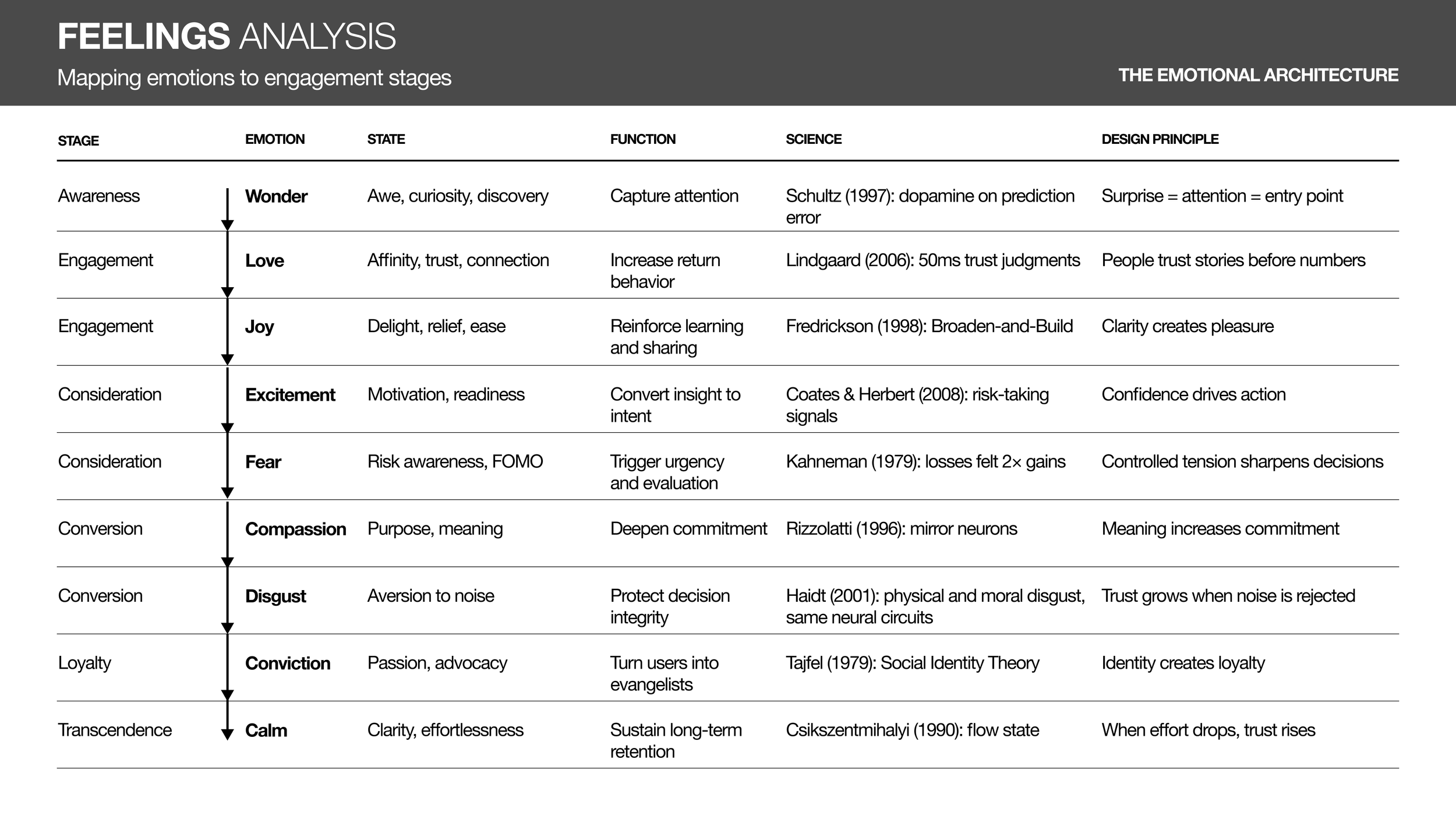
Joy was engineered as confidence + clarity + belonging (not “cute”).
Karma positioned itself as 'The Economist on video for the next generation.' This positioning exploits a cognitive gap: older financial media, in general, speak to System 2 (analytical, slow), but younger investors, in general, make initial decisions with System 1 (intuitive, fast) and engage System 2 only when emotionally hooked.

The Impact I Created
As the Head of UX, my role was to consult with the in-house team, build this product under a tight deadline and budget, and turn the fortune around because version 1.0 had failed.
I had full access to the C-Suite leadership, including the CEO from the multibillionaire Hinduja family, and collaborated with an 8-person team that comprised 2 product management heads, 2 designers, 1 content writer, 1 project manager & 2 marketing strategists.
What I helped accomplish
Optimized the design process timeline by 25% using Joyful Design Process
Helped achieve a 5x bump in user traffic on the website after launch. Reduced cognitive load + improved first-impression aesthetics + trust signals = lower bounce rate + higher engagement
Improved team collaboration & engagement and helped achieve the best outcomes using joyful methods from my toolkit
Defined, refined, and improved product vision and value proposition by collaborating with Karma leadership
Set a foundation of solid design principles and a design vision for future growth
Enabled transparency, alignment, and contact awareness among the stakeholders throughout the product redesign lifecycle
Delivered user-centric & business-friendly product solutions by implementing prioritization processes
How I helped accomplish it
Led extensive user research to test and validate product needs and ideas
Collaborated with the product management team to frame the research objectives, define the approach, develop a prototype, prepare a moderator guide and drive research with the team from analysis to insights
Spearheaded the project scoping to present the final design strategy and prototype
Led the product idea transformation into actionable concepts while considering the financial implications and the overall business objectives
Owned the full design process that resulted in timely, detailed, and polished deliverables
Guided the team to define a target state customer journey while highlighting key areas of improvement and innovation opportunities
Planned, designed & led initiatives like cross-disciplinary idea generation, client co-creation sessions & workshops with cross-functional leadership.
The ancient Indian concept of Karma itself means 'action with intention.' Every design decision was intentional. Every UX element had a cognitive rationale. Every interaction was designed to move the user from awareness to action with joy as the vehicle.
As per Forrester, every $1 invested in user experience design yields a return of $100, i.e., 9,900% ROI. We leveraged such metrics to highlight the value of design, creating design awareness and eventual design maturity.

The process: Emotions are the operating system. Content is the interface. Loyalty is the outcome.
Discover and Define: Business interviews, user personas, empathy maps, user interviews, user journey: media consumption behavior and action map, comparative analysis, value proposition, UX strategy with problem and goal definitions, feature list and use cases, feature prioritization, and analysis. Leading the product design team, my goal was to go beyond what users say they like and dislike to understand how consuming the Karma content fits into their lives.
Ideate and Refine: Co-creation workshops, white-boarding sessions, storyboarding, flows, concept explorations, and evaluation.
Create and Adjust: Wireframes, site map, visual designs, prototype, and testing.
Deliver and Release: Style guide and final files delivered for development
Neuro-UX Design principles for this project
Reduce cognitive load
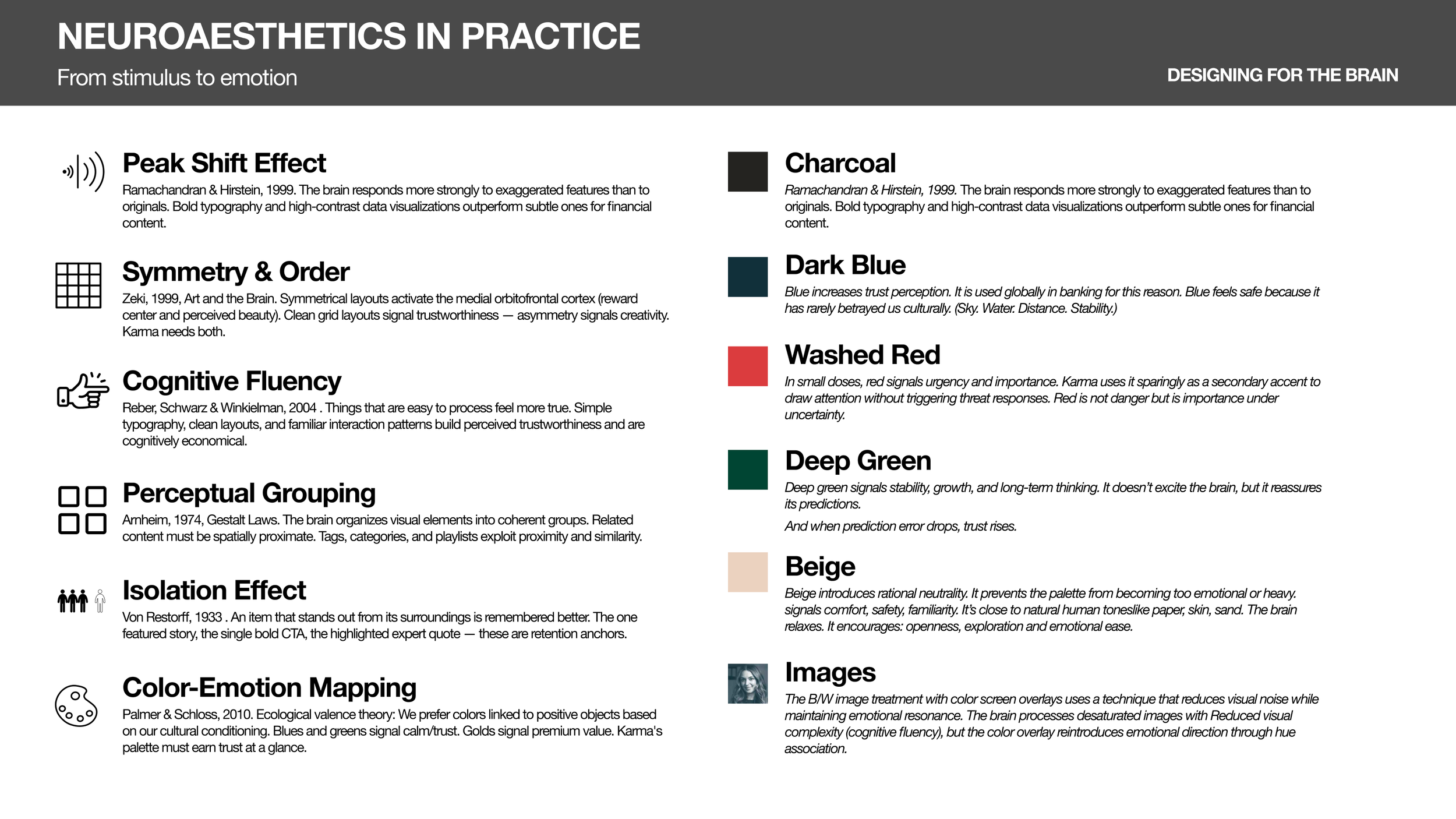
Miller's Law: working memory holds 7±2 items. Every screen must present no more than 5-7 content choices. The homepage uses text headlines under 200 characters linking to deeper content — exactly what the journey map prescribed.
Design for the 5-minute window
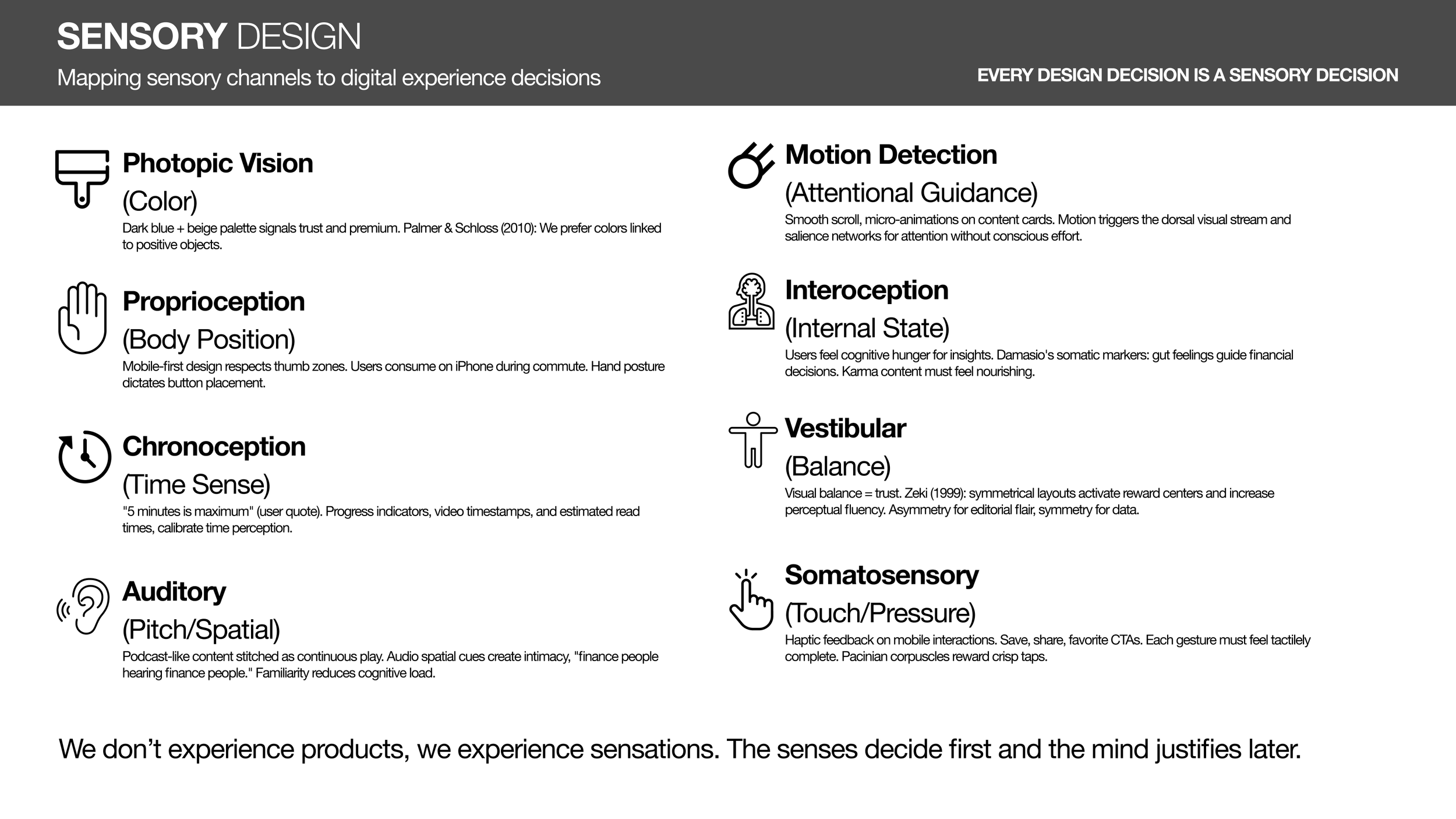
The investor consumes content between meetings on an iPhone. Every piece of content must deliver its core insight within 3-5 minutes. Longer pieces must have clear save-for-later and resume functionality.
Personalize to reduce noise
The reticular activating system (RAS) filters 99% of sensory input. Likewise, personalization acts as a digital RAS, surfacing only what matters to this investor. LinkedIn integration provides the data layer.
Make trust visible
Every content piece needs visible author credentials, publication dates, and source attribution. The anterior insula (the brain's fraud detector) activates when these signals are missing.
Enable social proof
Share counts, community reactions, and peer engagement metrics must be visible. The brain's mirror neuron system literally copies the behavior of trusted peers.
Create progressive disclosure
Don't show everything at once. The Zeigarnik Effect says the brain remembers incomplete tasks better. Layered content (from headline to summary to full piece to actionable insight) keeps users pulling deeper.
Reward consistently
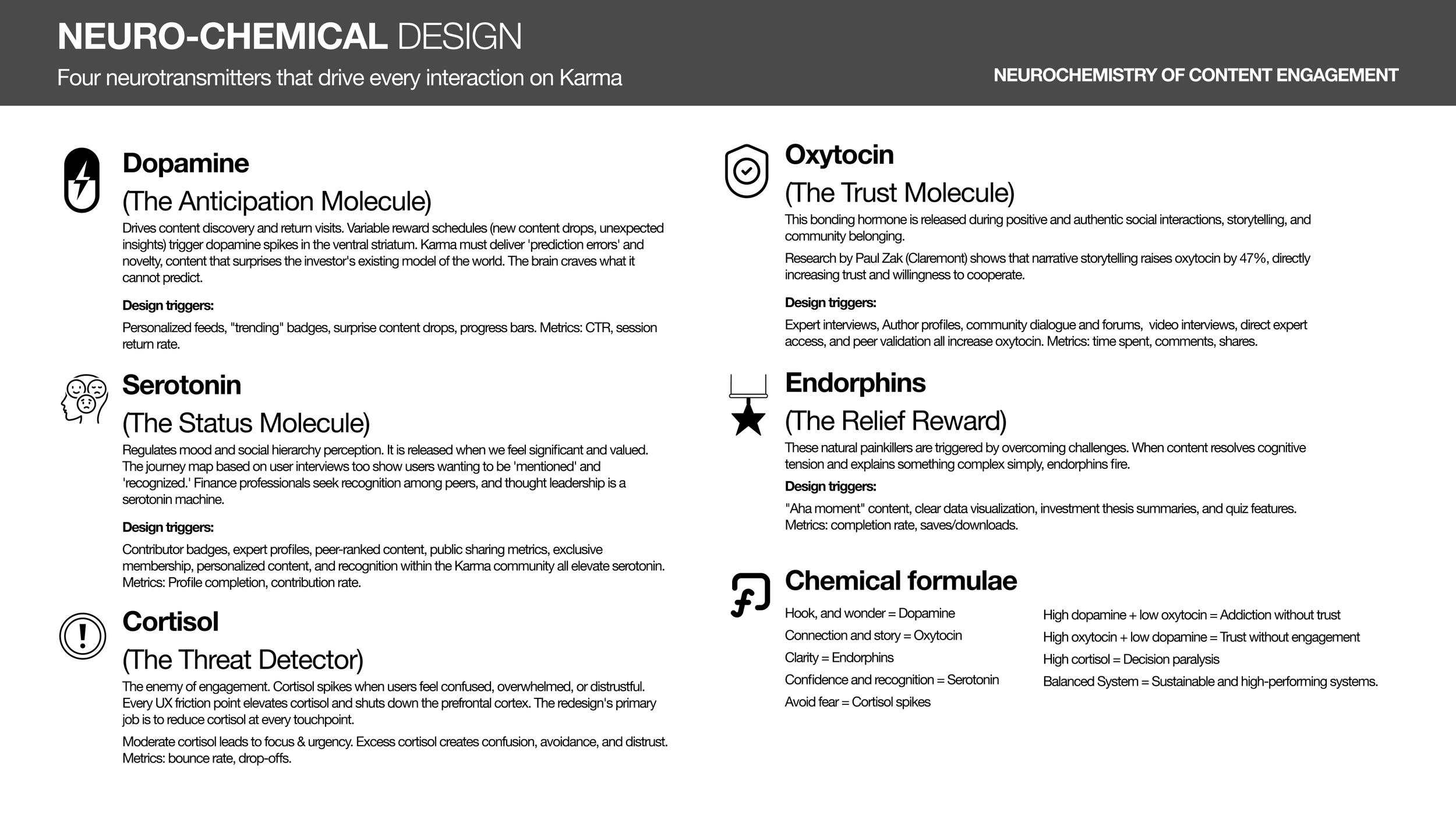
Variable ratio reinforcement schedules (new content drops at unpredictable intervals) create the strongest engagement loops. Daily newsletters provide the baseline. Unexpected exclusive reports provide the dopamine spike.
Focus on Purpose
Action aligned with purpose creates sustained engagement. Karma's name itself invokes this principle. The platform's mission, 'informed action for impact,' is spiritual in nature.
Build neural trust pathways
Cognitive trust: Competence signals. Expert correspondents from major media. Data-driven analysis. Cited sources.
Behavioral trust: Consistency of action. Regular content delivery. Predictable quality. Platform reliability.
Affective trust: Emotional resonance. Human-centered storytelling. Personal narratives from investors. Vulnerability and authenticity. The limbic system builds affective trust through repeated positive emotional associations.
Community trust: Social validation. Peer endorsements. Shared investment successes. Group identity formation. Mirror neurons and oxytocin work together: seeing others trust Karma literally changes the observer's neurochemistry. Research on oxytocin shows that belonging to a trusted group activates the same neural reward pathways as receiving a financial bonus.
Designing for the mind, body and spirit
Through the union of stimulus, response, and transient emotion, the aesthetic experience is born.
— Bharata Muni, Natyashastra, Chapter 6 (~200 BCE)
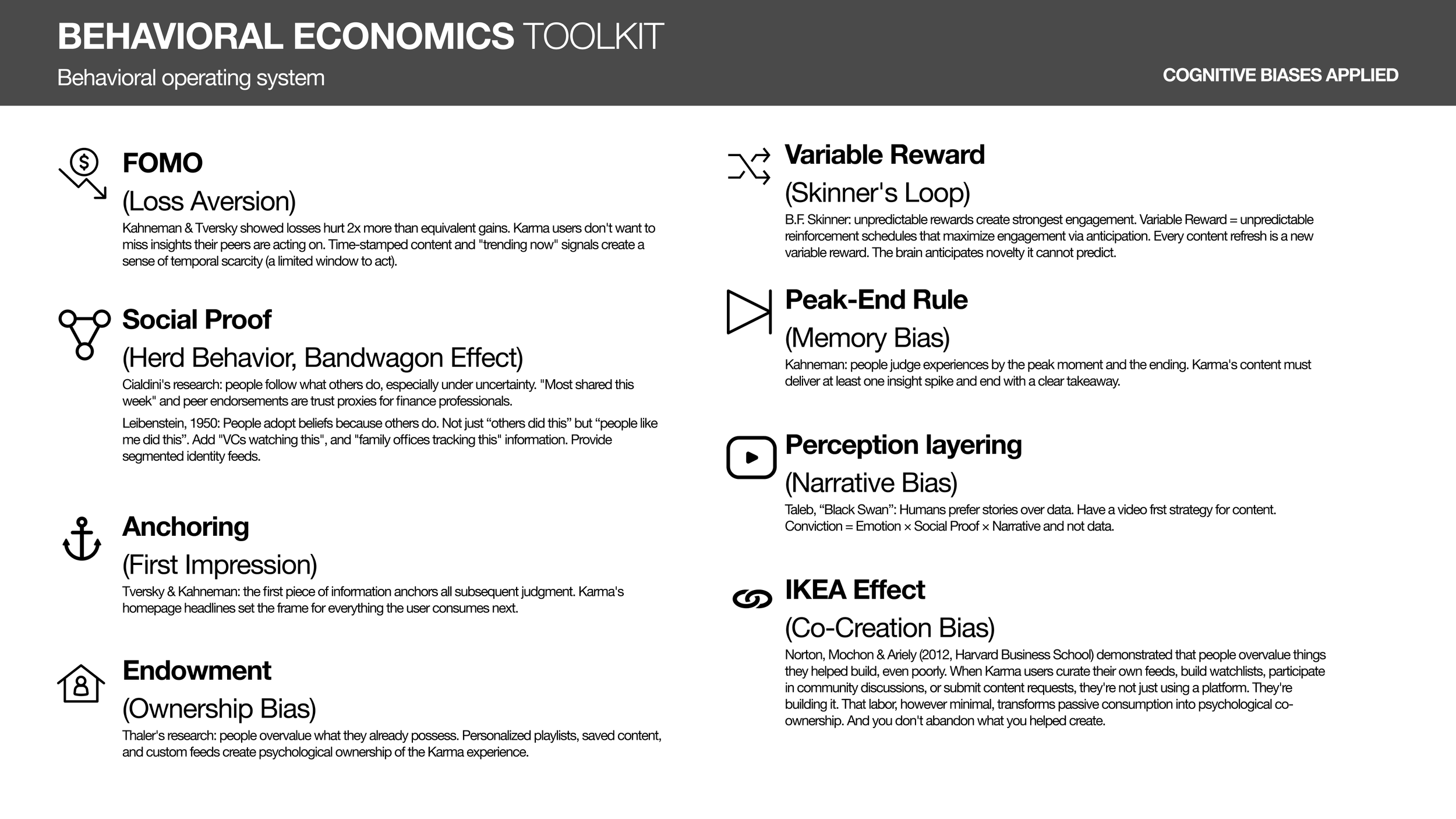


Style guide and final files delivered for development
Joyful design thesis
In ancient philosophies, real joy or a deep, abiding bliss arises from understanding. It is joy that comes not from pleasure, but from insight. That is the kind of joy Karma was designed to deliver through content experience.
Joy is a strategic advantage, not a soft metric. Barbara Fredrickson's Broaden-and-Build Theory (2001) demonstrated that positive emotions literally expand cognitive capacity. When the brain is in a positive state, the prefrontal cortex has wider access to working memory, creative problem-solving, and peripheral information processing.
For investors, this means something concrete: a joyful experience does not just feel nice, it actually makes them smarter consumers of information. They notice more. They connect more dots. They make better decisions.
When users feel joy, they process more, remember more, and make better decisions. Joy is not a design garnish; it is a cognitive enhancer.
The Joyful Design process applied to Karma worked because it treated joy as a neurological tool rather than an aesthetic preference. Every co-creation workshop, every user interview, every prototype test was designed to elicit and measure positive emotional response alongside functional usability.
Key learnings and reflections
What the pivot taught us: Despite the effective redesign, Karma later pivoted to reduce video production overhead and incorporate more printed content. This is itself a lesson in behavioral economics: the sunk cost fallacy. The team was wise enough to abandon a strategy that was operationally unsustainable, even when the design was performing. The brain wants to persist with what it has invested in (endowment effect). Good decision-making requires overriding that impulse, which Karma did. The product remains live at karmaimpact.com, which has evolved, but is built on the UX established by the redesign.
A serious investor platform should optimize for confidence per minute, not impressions per page.
Emotions are not the enemy of rational investing. They are the prerequisites (Damasio's Somatic Marker Hypothesis). Without emotional engagement, no decision gets made. People decide with the limbic brain, then rationalize with the neocortex. Loss aversion (Kahneman & Tversky, 1979): Investors fear losing 2.5x more than they enjoy gaining. The UX must reduce perceived risk at every step.
Simplicity is not minimalism, it is the absence of disgust. Users' aversion to inauthentic content, noise, and gimmicks is the brain's trust-protection system.
What people I worked with have to say
"Himanshu and I worked on a project together where he took ownership of all aspects of the UX process from discovery to design under a tight timeframe. When I learned we might be working together I was excited to have him on the team because of his great reputation, and the experience of working together exceeded my expectations.
Having Himanshu lead our UX process brought a level of creativity, design execution, and collegial professionalism that made every day working together a pleasure. He's not only great at his job but also a great person to work with on a day-to-day basis.
I will definitely plan to work with him again at the first chance I am given, and anyone who has an opportunity to have Himanshu work on their team should jump at the chance. Thanks, Himanshu!"
Alex Christison, Co-Head of Product & Agile, Trunk Digital
"Working with Himanshu was a joy and yielded great results. We're really happy with the designs he submitted for our website, which are both gorgeous and intuitive. He also made all of our working and brainstorming sessions fun and knew how to get people involved."